

9 min read – Last updated May 28, 2026
- On May 27, 2026, America’s Credit Unions publicly backed an NCUA proposal to ease supervision of indirect (dealer-arranged) auto lending. If finalized, fewer dealer-arranged loans will get pre-funding credit union review.
- “Ghost car” loan fraud, where a dealer or third party fabricates VIN, title, or borrower data to push through a financing application, has spiked into 2026 per CUInsight and CUToday reporting.
- The three buyer-side verifications that catch both markup abuse and fraud: confirm the lender, confirm the APR matches the contract line by line, and confirm the VIN and title chain before the F and I office prints anything.
- A pre-approval from your own bank or credit union, issued before you walk in, is the cheapest defense against both undisclosed markups and indirect-lending fraud.
In this article
- What the May 2026 NCUA proposal actually does
- Why this matters even if you do not bank with a credit union
- Verification 1: confirm the lender on the contract is real
- Verification 2: match the APR on the disclosure line by line
- Verification 3: confirm the VIN and title chain before you sign
- The pre-approval workaround
- Frequently asked questions
Daniela, a 34-year-old physician’s assistant in Phoenix, closed on a 2024 Honda CR-V last week and signed a 60-month loan at 8.4 percent APR through a credit union she had never heard of. Her pre-approval letter from her primary bank read 6.9 percent. The 1.5-point gap on her $28,400 contract works out to $1,847 in extra interest. The credit union is real, the loan is real, and the dealer’s finance manager did nothing illegal. The cost of skipping a verification step is just sitting inside her contract.
What the May 2026 NCUA proposal actually does
On May 27, 2026, CUToday and CUInsight reported that America’s Credit Unions, the industry’s main trade association, formally backed a National Credit Union Administration proposal to ease supervisory expectations on indirect auto lending. Indirect lending is when the loan paperwork is generated at the dealership rather than at the lender’s branch. Roughly 80 percent of new-car loans in the United States flow through that channel, per CFPB data, and a large share of used-car loans do too.
The proposal does not abolish oversight. It would relax certain pre-funding review and dealer-management expectations that the NCUA layered on after the 2014 to 2016 enforcement wave. Credit union trade groups argue the existing rules created a competitive disadvantage against banks. Consumer protection advocates have flagged the shift as one that gives dealers more room to set the terms with less third-party review.
The practical effect for a buyer signing in 2026: more dealer-arranged contracts will move through the system with less back-end review of how the loan was structured, what was marked up, and what was disclosed. The contract is still binding either way. Buyers carry more of the verification burden than they did under the prior regime.
Why this matters even if you do not bank with a credit union
Indirect lending touches every major lender type. The dealer’s F and I office runs the credit application through a software platform such as RouteOne or Dealertrack, which fans the file out to multiple banks, captive finance companies, and credit unions at once. The finance manager picks the offer that maximizes dealer compensation, marks up the rate (commonly 1 to 2 points per CFPB enforcement filings), and presents the marked-up number on the contract.
That structural opacity is also where loan fraud creeps in. A May 26, 2026 CUInsight piece titled “Your auto loan passed every credit check. That’s how the fraud works” detailed a growing pattern: applications that pass automated underwriting because the credit data is genuine, but the vehicle data (VIN, title, sometimes even the existence of the car) has been fabricated. CUToday’s “Fake Deals, Real Loans: How Ghost Cars Are Complicating Auto Lending” coverage from the same week described the same dynamic from the lender side.
Less mandatory back-end review means more of these end up funding. The borrower discovers the problem only when the title does not arrive, the VIN does not match the registered vehicle, or the loan servicer cannot produce the original collateral lien documents. By then the loan is on the books.
Verification 1: confirm the lender on the contract is real
The first line to verify on a dealer-arranged loan is the lender’s legal name on the retail installment sales contract. Not the dealer’s name. Not “ABC Finance.” The actual lender. Then look it up.
Banks should appear in the FDIC’s BankFind database. Credit unions should appear in the NCUA’s research portal. Both lookups are free and take less than a minute on a phone in the finance office. If the entity on the contract does not appear in either system, the loan is not federally insured and either the dealer used a non-bank subprime lender (legitimate, but usually expensive) or something is wrong with the paperwork.
Buyers should also confirm that the lender’s contact information on the contract matches what is on the lender’s website. Phone numbers, mailing addresses, and online payment portals listed on the contract should match the verified entity. A mismatch is the most common early indicator of a fabricated indirect-lending file, per CUInsight’s reporting.
Verification 2: match the APR on the disclosure line by line
Federal Truth in Lending requires the dealer to provide a Federal Box disclosure listing the APR, finance charge, amount financed, total of payments, and total sale price. Read those numbers against the rest of the contract before signing.
The most frequent error pattern is the APR on the Federal Box differing from the APR shown on the payment schedule, the amortization breakout, or a separate “credit insurance” or “GAP” add-on disclosure. When that happens, the higher number is what the contract actually charges. The Federal Box has to be accurate to the rate that produces the payment schedule, not the rate the salesperson quoted verbally.
This is where the dealer markup gap between buy rate and sell rate shows up. The marked-up sell rate is what produces the actual payments. A 1-point gap on a $28,000 60-month loan adds roughly $1,000 in interest. A 2-point gap adds roughly $2,100. Catching it on the disclosure line before signing is the only point in the process where the buyer has leverage.
Verification 3: confirm the VIN and title chain before you sign
Read the VIN on the contract, then walk back to the car and read the VIN on the dashboard plate and the driver-side door jamb sticker. All three should match exactly. A mismatch (even a single digit) means either a paperwork error that will delay the title, or a deeper problem that should not get funded.
Then ask for a copy of the dealer’s title work showing the chain of ownership. Title washing and skip-rebuild title fraud often surfaces here. The buyer is paying for clean ownership transfer. If the dealer cannot show the title chain or refuses to provide it before signing, that is a hard stop. For background on why VIN documentation matters at the listing stage too, see our piece on why VIN-based research matters for used car buyers.
The pre-approval workaround
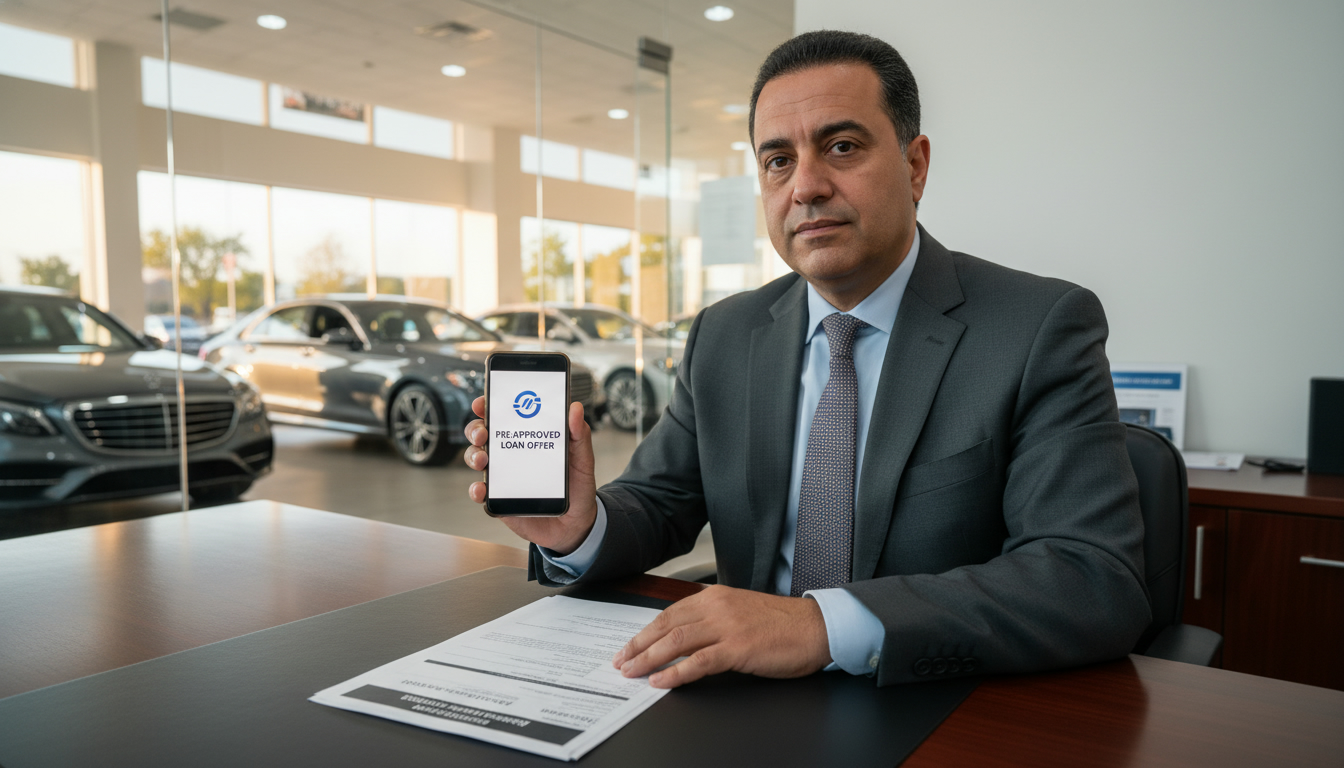
The cleanest defense against both markup abuse and indirect-lending fraud is to arrive with a pre-approval letter from your own bank or credit union in hand. A pre-approval converts the dealer’s loan offer from a take-it-or-leave-it quote into a competitive bid. The dealer either matches or beats your pre-approval rate, or you sign the loan with your own lender and let them pay the dealer directly.
When the loan funds through your bank or credit union, every verification step listed above happens on your lender’s side, not just yours. The institution running your file has every reason to confirm the VIN, the title chain, and the dealer’s documentation before sending money. That is the supervision the NCUA proposal is partially scaling back at the indirect channel. Routing through your own lender restores it. For more on how a pre-approval reshapes the finance office conversation, see how to create a car loan budget before you walk in.
Ready to compare your options? See current auto loan rates from top lenders and find the best fit for your budget.
Frequently asked questions
What is indirect auto lending?
Indirect auto lending is the channel where the loan paperwork is generated at the dealership, not at the lender’s branch. The dealer’s finance office submits your credit application to multiple lenders at once, picks one offer, marks up the interest rate, and presents the contract to you. Roughly 80 percent of new-car loans and most used-car loans flow through this channel.
Does the NCUA proposal mean dealer loans are now riskier?
The proposal eases supervisory expectations on credit unions that originate indirect loans. It does not change the contract you sign or your legal rights. It does shift more verification work from the lender’s back-end review onto the buyer at signing. Risk depends on how thoroughly you check the lender, the APR, and the VIN before signing.
How do I tell if a dealer-arranged lender is legitimate?
Look the lender up in the FDIC BankFind database (banks) or the NCUA research portal (credit unions). Both are free. Confirm the contact information on the contract matches what is on the lender’s own website. If the entity does not appear in either federal database and is not a known non-bank captive finance company (Toyota Financial Services, Ford Credit, GM Financial, Honda Financial Services), ask the dealer for documentation before signing.
What is a ghost car loan?
A ghost car loan is one funded against a vehicle that does not match the loan paperwork, sometimes because the VIN was fabricated, sometimes because the vehicle does not exist, sometimes because the title chain is forged. CUInsight and CUToday have covered the pattern through 2026. The simplest defense is to read the VIN on the contract, then walk to the car and confirm it against the dashboard plate and door jamb sticker before signing.
Should I always use a pre-approval instead of dealer financing?
Not always. Captive finance arms (Toyota Financial, Ford Credit, GM Financial) regularly run promotional rates at 0 or 1.9 percent on specific models that beat what any bank or credit union will offer. Get a pre-approval anyway, then compare it against the dealer’s offer in the finance office. Sign with whichever lender produces the lowest APR after all add-ons are stripped out.