

By MyAutoResource Editorial Team · Reviewed by Steven Sun · 6 min read · Updated August 3, 2026
- The deduction caps at $10,000 a year and covers interest on new-vehicle loans taken out after December 31, 2024, for tax years 2025 through 2028.
- Only vehicles with final assembly in the United States qualify. Used vehicles never qualify, no matter how they’re financed.
- The deduction phases out starting at $100,000 modified adjusted gross income (MAGI) for single filers and $200,000 for joint filers, dropping $200 for every $1,000 of income above that line.
- On a typical $35,000 loan at today’s average new-car rate, year-one interest runs about $2,059, well under the $10,000 cap, so for most buyers the vehicle test decides the deduction, not the dollar limit.
In this article
- A Deduction With Two Separate Tests
- Where the Car Was Built Decides More Than the Sticker
- The Income Phase-Out Most Buyers Will Never Hit
- What the Deduction Is Actually Worth on a Real Loan
- Frequently asked questions
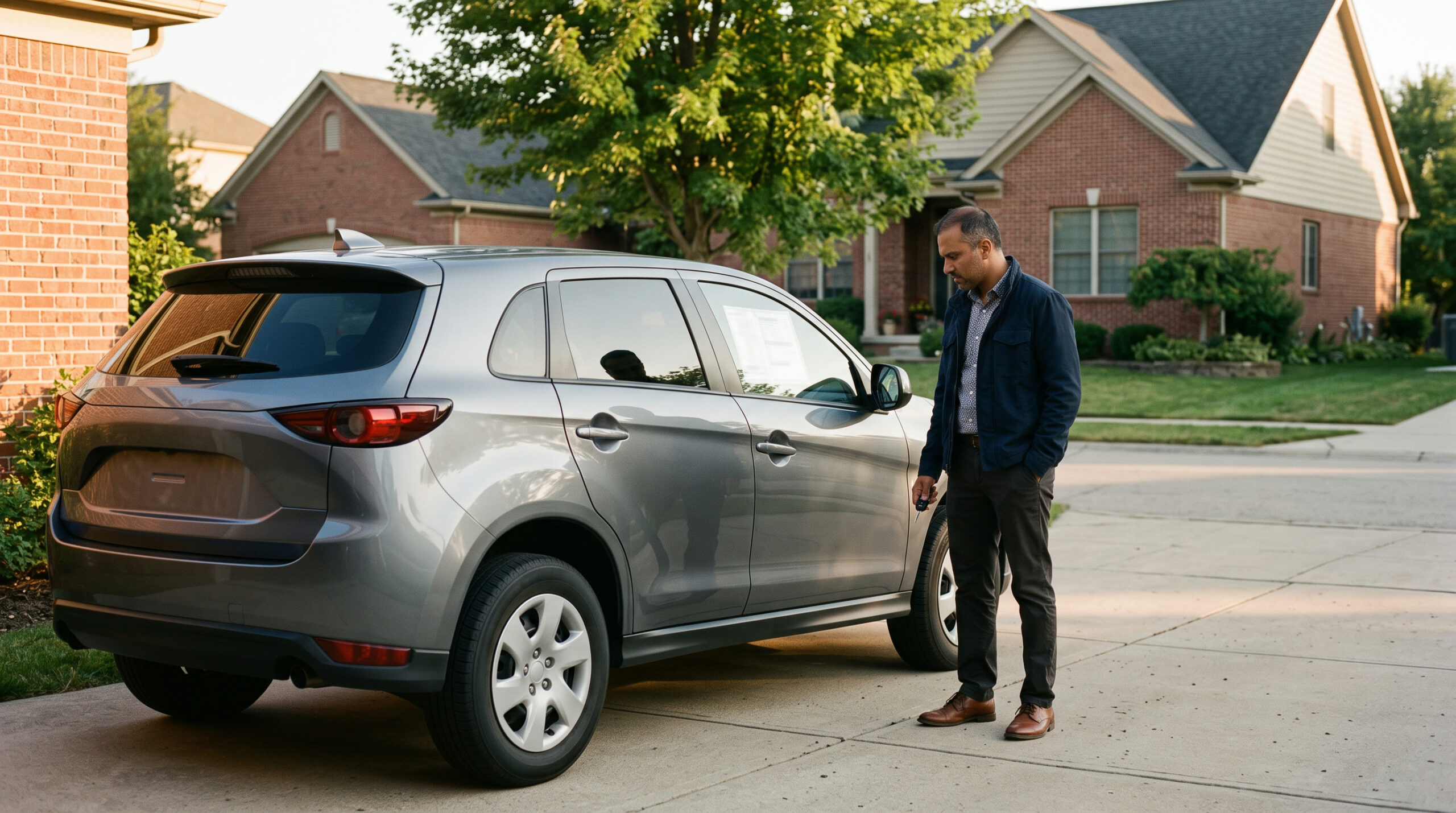
Priya Desai financed a $35,000 SUV in March 2026 and assumed the new auto loan interest deduction would cover whatever she paid in interest that year. It might not, and the reason has nothing to do with her credit score or her loan amount. It has to do with where the SUV was built.
The One Big Beautiful Bill Act (OBBBA), the 2025 federal tax law that created this deduction, lets qualifying buyers write off up to $10,000 a year in car loan interest without itemizing. The Internal Revenue Service (IRS) confirmed the rules in guidance issued January 2, 2026, alongside a formal proposed rule in the Federal Register. It sounds simple. It isn’t, because it runs two tests at once: what the car is, and how much the buyer earns.
A Deduction With Two Separate Tests
The deduction applies to interest paid on loans for a qualified passenger vehicle: a car, minivan, van, SUV, pickup, or motorcycle under 14,000 pounds gross vehicle weight rating (GVWR), which is the maximum loaded weight the manufacturer rates the vehicle to carry safely. It covers interest on loans taken out after December 31, 2024, for tax years 2025 through 2028. After 2028, the deduction is set to expire unless Congress renews it.
The loan has to be secured by the vehicle, and the vehicle has to be for personal use, not a small business fleet. Interest above $10,000 in a single year is not deductible.
Where the Car Was Built Decides More Than the Sticker
This is the part that trips up buyers who assume “American brand” is the same test as “American-built.” It is not. The IRS test is final assembly in the United States, checked at the vehicle level, not the brand level. A US-nameplate vehicle assembled in Mexico or Canada does not qualify. A foreign-nameplate vehicle assembled at a US plant can.
The IRS points buyers to two ways to check: the vehicle information label affixed to the car at the dealership, and the VIN, which encodes the plant of manufacture. Neither requires guesswork. Before signing a loan you plan to deduct interest on, ask the dealer to show you the label.
Used vehicles are excluded entirely, regardless of where they were built or how the purchase is financed. There is no version of a used-car purchase that qualifies.
The Income Phase-Out Most Buyers Will Never Hit
The deduction starts phasing out once modified adjusted gross income (MAGI), which is roughly your adjusted gross income with a few items added back, crosses $100,000 for single filers or $200,000 for joint filers. For every $1,000 of income above that threshold, the maximum deduction drops by $200. The deduction reaches zero at $150,000 MAGI for single filers and $250,000 for joint filers.
A single filer with $120,000 MAGI is $20,000 over the threshold. At $200 of reduction per $1,000, that’s a $4,000 cut, leaving an effective cap of $6,000. For most buyers, that reduced cap still covers their actual interest paid, so the phase-out mostly matters to higher earners financing expensive vehicles.

What the Deduction Is Actually Worth on a Real Loan
Here’s where the $10,000 cap turns out to be less generous than it sounds for a typical buyer. Take a $35,000 new-vehicle loan at a 6.39% annual percentage rate (APR), the average new-car rate lenders were charging in early 2026, financed over 60 months. In year one, the buyer pays about $2,059 in interest. Over the full 60-month term, total interest comes to roughly $5,981.
Neither figure comes close to the $10,000 annual cap. That means for a typical buyer at a typical rate and loan amount, the dollar cap is not the binding constraint at all. The vehicle-eligibility test is.
A buyer who finances the exact same $35,000 at the same terms but chooses a used vehicle or one assembled abroad gets zero deduction, not a smaller one. The deduction is not a discount that scales down with a lower-value car; it’s a switch that’s either on or off.
At a 22% marginal tax rate, that $2,059 in year-one interest is worth about $453 in reduced tax liability, assuming the buyer’s total itemizable and above-the-line deductions otherwise leave them owing tax at that rate. Compare that to a used car buyer with the same $35,000 balance at the average used-car rate of 11.43%, per Experian’s Q1 2026 average car loan interest rate data, who would pay about $3,718 in year-one interest, none of it deductible under this rule.
Before you assume a new-car loan pencils out because of this deduction, run your own year-one interest number against your marginal tax rate. For most buyers the real savings land in the hundreds of dollars, not the thousands the $10,000 headline implies. Related reading: how loan term length changes total interest on a $30,000 auto loan and what APR drift means for buyers timing their application.
Frequently asked questions
Does the auto loan interest deduction apply to used cars? No. Used vehicles are excluded entirely, regardless of where they were built or how the purchase is financed. Only new vehicles with final assembly in the United States qualify.
How do I know if my car’s final assembly is in the US? Check the vehicle information label affixed to the car at the dealership, or look up the plant-of-manufacture code encoded in the VIN. The brand name on the vehicle does not determine this; the assembly location does.
Do I need to itemize my taxes to claim this deduction? No. This is an above-the-line deduction, which means you can claim it whether you itemize or take the standard deduction.
What happens if my income is above the phase-out threshold? Your maximum deduction shrinks by $200 for every $1,000 your MAGI exceeds $100,000 (single) or $200,000 (joint). It reaches zero at $150,000 (single) or $250,000 (joint).
How long is this deduction available? It applies to tax years 2025 through 2028 under current law. After that, it expires unless Congress extends it, which is already being debated in tax policy circles as of mid-2026.