
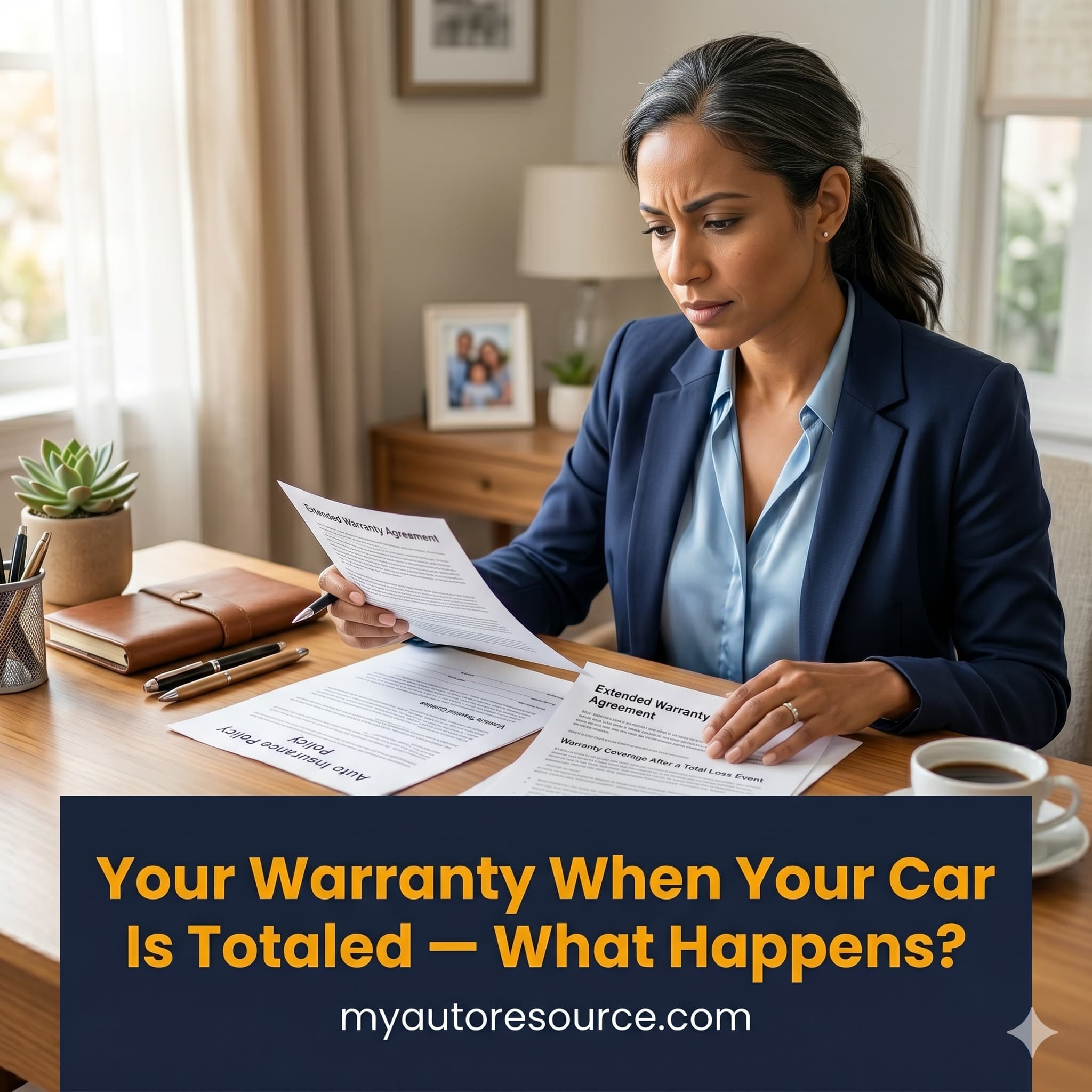

You bought an extended warranty on your 2021 CR-V two years ago — $1,800, rolled into your loan, covering three years or 36,000 additional miles. At 14 months in, the car is totaled in an accident. Your insurance pays the actual cash value. Your loan is paid off (assuming you had gap coverage). And your extended warranty, with 22 months of coverage remaining, has effectively disappeared. You’ve paid for protection you can no longer use. Whether you get any of that money back depends entirely on the specific terms of your warranty contract and how quickly you act after the loss.
An extended warranty on a totaled vehicle does not automatically transfer to your replacement car. Most contracts allow a pro-rata refund of unused premium, but you must request it — it will not be issued automatically. The refund process has a deadline, typically 60 to 90 days after the loss event.
What Extended Warranty Contracts Typically Say About Total Loss
Extended warranty contracts include a section on cancellation terms that governs what happens when the covered vehicle is totaled, stolen and not recovered, or otherwise removed from service. The standard language allows the contract holder to request cancellation and receive a pro-rata refund of unused premium based on either time or mileage elapsed — whichever method the contract uses.
Pro-rata by time means: if you had 36 months of coverage remaining and used 14, you’ve used roughly 39 percent of the coverage period. The refund would be approximately 61 percent of the original premium, minus any administrative cancellation fee (typically $25 to $75). On an $1,800 warranty, that’s roughly $1,098 minus the fee.
Some contracts use mileage as the pro-rata basis rather than time. If your contract provided coverage for 36,000 miles and you drove 12,000 of them, you’ve used one-third, and the refund is approximately two-thirds of the premium.
The Bankrate notes that dealer-sold financial products including extended warranties are financed at the loan’s interest rate when rolled into an auto loan. If you financed your $1,800 warranty and your pro-rata refund is $1,098, that refund goes to your lender to reduce the loan balance — not directly to you. In a total loss scenario where you had adequate gap coverage and your loan is already satisfied, any refund above the loan payoff comes to you.
The Refund Process and Timeline
To claim a pro-rata refund on an extended warranty after a total loss, you typically need:
– Written notice to the warranty provider (not the dealer) within the contract’s specified window (usually 60 to 90 days after the loss)
– Proof of the total loss: insurance settlement letter or equivalent documentation
– Your contract number and covered VIN
The refund is processed back to the lienholder if the vehicle had an outstanding loan. If the vehicle was owned free and clear, it goes to the contract holder. If you rolled the warranty into your auto loan that was covered by gap insurance, the sequence is: gap insurance pays the loan difference, warranty cancellation refund reduces any remaining balance, and any remaining credit comes to you.
How Lender Insurance Requirements and Gap Coverage Work at Total Loss covers the loan balance settlement sequence in more detail. The extended warranty refund is typically the last step in that sequence, and it’s one that many borrowers overlook because it requires proactive action rather than automatic processing.
Can You Transfer an Extended Warranty to a New Vehicle?
Most extended warranty contracts are not transferable to a new or different vehicle. The coverage is specific to the covered VIN. When that vehicle is totaled, the contract covers the vehicle’s remaining life — which is now zero — and the only recovery is the unused premium refund.
Some premium third-party warranty providers offer transfer programs, but these typically allow transfer to a subsequent owner of the same vehicle (for resale value purposes), not to a replacement vehicle. If you want coverage on your next car, you need a new warranty contract on the new VIN.
Act within the cancellation window — typically 60 to 90 days from the total loss event. Most warranty providers do not automatically issue refunds. If you miss the window, you forfeit the unused premium entirely, regardless of how much coverage remained.
Whether Extended Warranty Makes Sense Given Total Loss Risk
The total loss scenario is worth factoring into your warranty purchase decision. If you’re buying an extended warranty on a vehicle you plan to keep for 5 to 7 years, total loss before the coverage term ends is possible — particularly in the higher-mileage years when collision risk may be elevated. The warranty’s value in that scenario is limited to the pro-rata refund, not the full coverage benefit you planned on.
This doesn’t mean extended warranties are a poor choice. It means the total cost of ownership comparison should factor in the possibility that you won’t use the full term. Shorter warranty terms (2 years vs. 4 years) carry less exposure to the total loss forfeit scenario while still covering the highest-risk period of a high-mileage used car’s life.
Questions
About Extended Warranty and Total Loss
- What happens to my extended warranty if my car is totaled?
- Can I transfer an extended warranty to my replacement vehicle?
- How do I get a refund on an unused extended warranty?
- Does gap insurance affect my extended warranty refund?
- How long do I have to request a refund on an extended warranty after a total loss?
Not sure if extended coverage is worth it for your vehicle? Get a free auto warranty quote and compare your options before your manufacturer coverage runs out.