
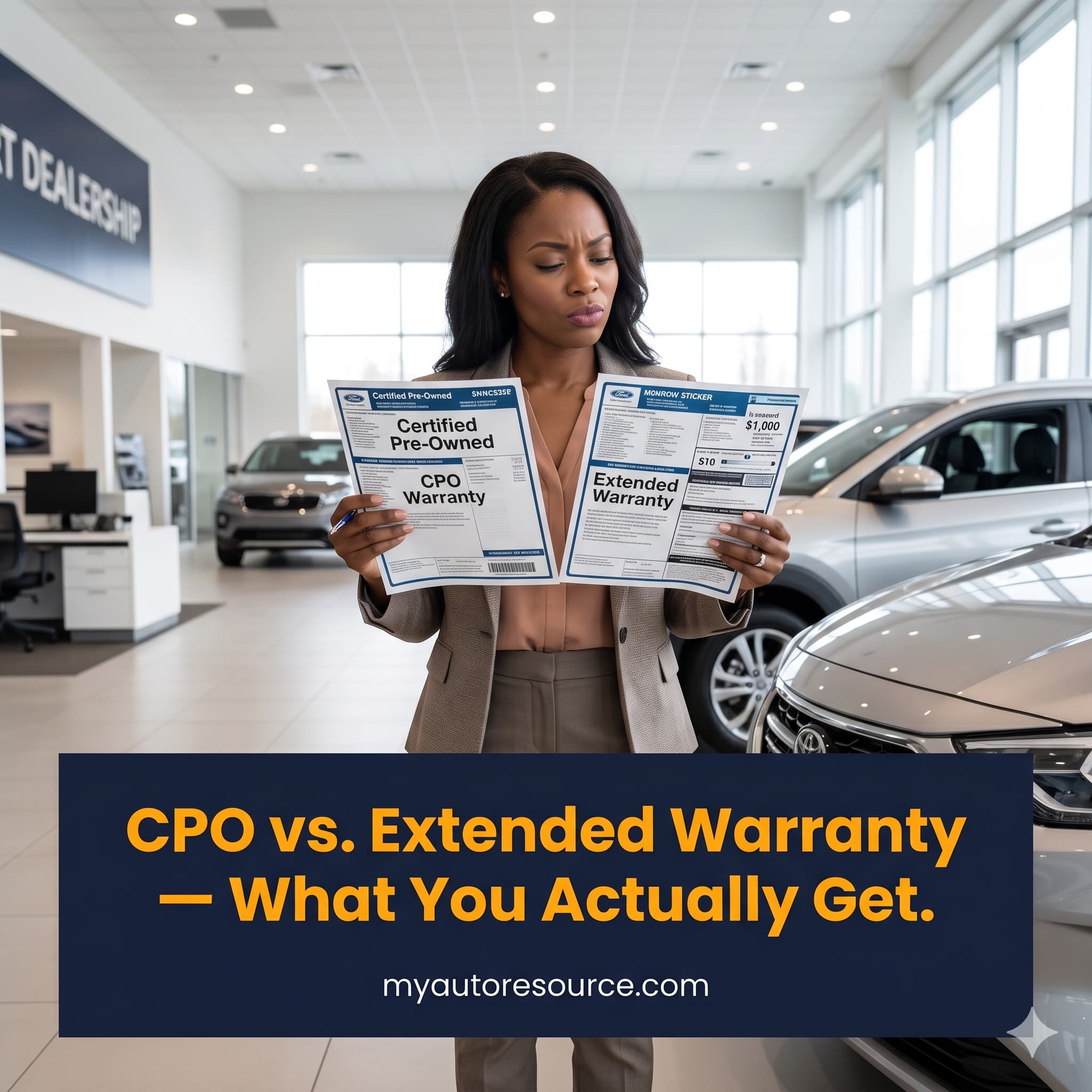

Same car. Two listings. The certified pre-owned 2022 Honda CR-V with 44,000 miles is priced at $29,500. The non-CPO same year, same model, with 47,000 miles is at $26,200. The $3,300 price gap is partly explained by the CPO certification, which includes a manufacturer-backed warranty. The question is whether that warranty is worth $3,300 more than what you’d pay for a quality third-party extended warranty added to the non-CPO vehicle. The answer depends on what each covers, how each pays out claims, and which failure scenarios you’re actually protecting against.
The CPO premium buys you manufacturer-backed coverage and typically eliminates the claims-denial risk that comes with some third-party warranties. The question is whether that assurance is worth $2,000 to $4,000 more than what third-party coverage would cost on the same vehicle.
What CPO Warranty Actually Covers
Manufacturer CPO programs are not standardized across brands. The coverage terms vary significantly between Toyota, Honda, GM, Ford, and others. Most CPO programs include:
A 12-point to 172-point inspection confirming the vehicle meets the manufacturer’s condition standards before certification. Powertrain coverage, typically extending the original powertrain warranty for an additional 1 to 5 years or 12,000 to 100,000 miles from original sale (terms vary). Comprehensive coverage that may include electrical systems, air conditioning, safety features, and navigation on higher-tier programs. Roadside assistance and, in some cases, trip interruption reimbursement.
The key advantage of manufacturer CPO coverage is the claims process. When you bring a CPO vehicle to a franchised dealership for a covered repair, the manufacturer pays the dealer directly. There is no adjuster reviewing your claim, no network approval requirement, and typically no deductible (though some programs have a per-visit deductible of $50 to $200). The CFPB’s auto loan resources note that warranty claim disputes are significantly lower for manufacturer-administered CPO programs than for third-party products.
What Third-Party Extended Warranty Offers
Third-party extended warranties vary enormously in quality and coverage. The best ones from established providers with direct-pay programs and strong claims reputations can cover essentially the same failure scenarios as a manufacturer CPO program — powertrain plus electronics, HVAC, and some comprehensive coverage — at 30 to 50 percent lower cost.
A quality third-party extended warranty for a 2022 Honda CR-V with 47,000 miles might cost $1,200 to $1,800 for a 3-year/36,000-mile comprehensive plan. The same vehicle as a CPO carries a $3,300 premium over a comparable non-CPO listing. Even accounting for the additional 3,000 miles and slight condition difference, the CPO premium includes roughly $1,500 to $2,500 in warranty cost above what third-party coverage would provide.
The risks of third-party coverage are real but manageable with selection. Coverage exclusions can be buried in contract terms. Claims approval may depend on pre-authorization from a central office. Some repairs require going to a specific network shop. The Bankrate’s analysis of financial protection products notes that third-party financial protection products have a wide range of quality, and provider reputation matters significantly.
The Cost Comparison at the Purchase Decision Point
The CPO vs. third-party comparison math depends on three variables: the CPO premium over a comparable non-CPO vehicle, the cost of equivalent third-party coverage, and the claims risk differential between the two.
Using the CR-V example: the non-CPO vehicle at $26,200 plus a $1,500 third-party warranty totals $27,700 in acquisition cost. The CPO at $29,500 represents $1,800 more for the same coverage period, assuming the third-party warranty is genuinely comparable. If the third-party warranty has meaningful exclusions (turbocharger, dual-clutch, hybrid components), the comparison shifts. If it covers everything the CPO covers, the $1,800 difference is pure value judgment: how much do you pay for the hassle reduction and claims reliability of manufacturer CPO?
For higher-mileage CPO vehicles, the math often shifts more in favor of CPO. A CPO vehicle at 65,000 miles with extended powertrain coverage to 100,000 miles is covering 35,000 of the highest-risk miles. Third-party coverage for those specific miles is priced higher to reflect the elevated failure probability.
If the CPO premium is $2,000 or less and the coverage extends 2 or more years past what third-party coverage would offer at comparable cost, CPO typically wins. If the premium exceeds $3,000 and quality third-party coverage is available for the same vehicle, the non-CPO route often delivers more value per dollar.
Where CPO Has Clear Advantages
Three scenarios where CPO coverage is worth the premium:
You’re buying from a brand with strong CPO coverage (Toyota, Honda, some German brands). Manufacturer CPO on these vehicles is consistently backed with no-hassle claims and comprehensive coverage terms that are hard to replicate with third-party products at similar price points.
The vehicle is under manufacturer powertrain warranty through the CPO program’s extended term. If a 2022 Honda CR-V’s CPO extension runs to 7 years or 100,000 miles from original sale, you may be getting 3 years of remaining coverage that starts now. That’s a concrete, manufacturer-backed term with known exclusions.
You plan to trade or resell within the CPO warranty period. Certified pre-owned status is transferable with many manufacturer programs and adds resale value to future buyers. Third-party warranties are often non-transferable.
When Non-CPO Plus Third-Party Makes More Sense
If the CPO premium is $3,000 or more, equivalent third-party coverage from a reputable provider costs $1,000 to $1,500, and you have flexibility on which repair shop you use, the non-CPO math often wins. The key is selecting a third-party provider carefully: prioritize providers with direct-pay to any ASE-certified shop, a documented claims approval process, and at least a decade of operations.
You can often negotiate the dealer’s third-party warranty price down by 20 to 30 percent, or purchase third-party coverage within 30 to 90 days of purchase from an independent provider at prices below what any dealership offers.
Questions About CPO Warranty vs. Third-Party Extended Warranty
- Is CPO coverage better than a third-party extended warranty?
- How much extra does a certified pre-owned car cost compared to a non-CPO?
- What does a CPO warranty cover that a third-party warranty might not?
- Can I add a third-party warranty to a non-CPO used car?
- Does CPO warranty transfer if I sell the car?
Not sure if extended coverage is worth it for your vehicle? Get a free auto warranty quote and compare your options before your manufacturer coverage runs out.