

Your down payment and insurance coverage can both play important roles in vehicle financing. Understanding the lender’s requirements before applying can help you prepare for the purchase.
Imagine you financed $36,000 of a $38,000 car. That’s about 5 percent down.
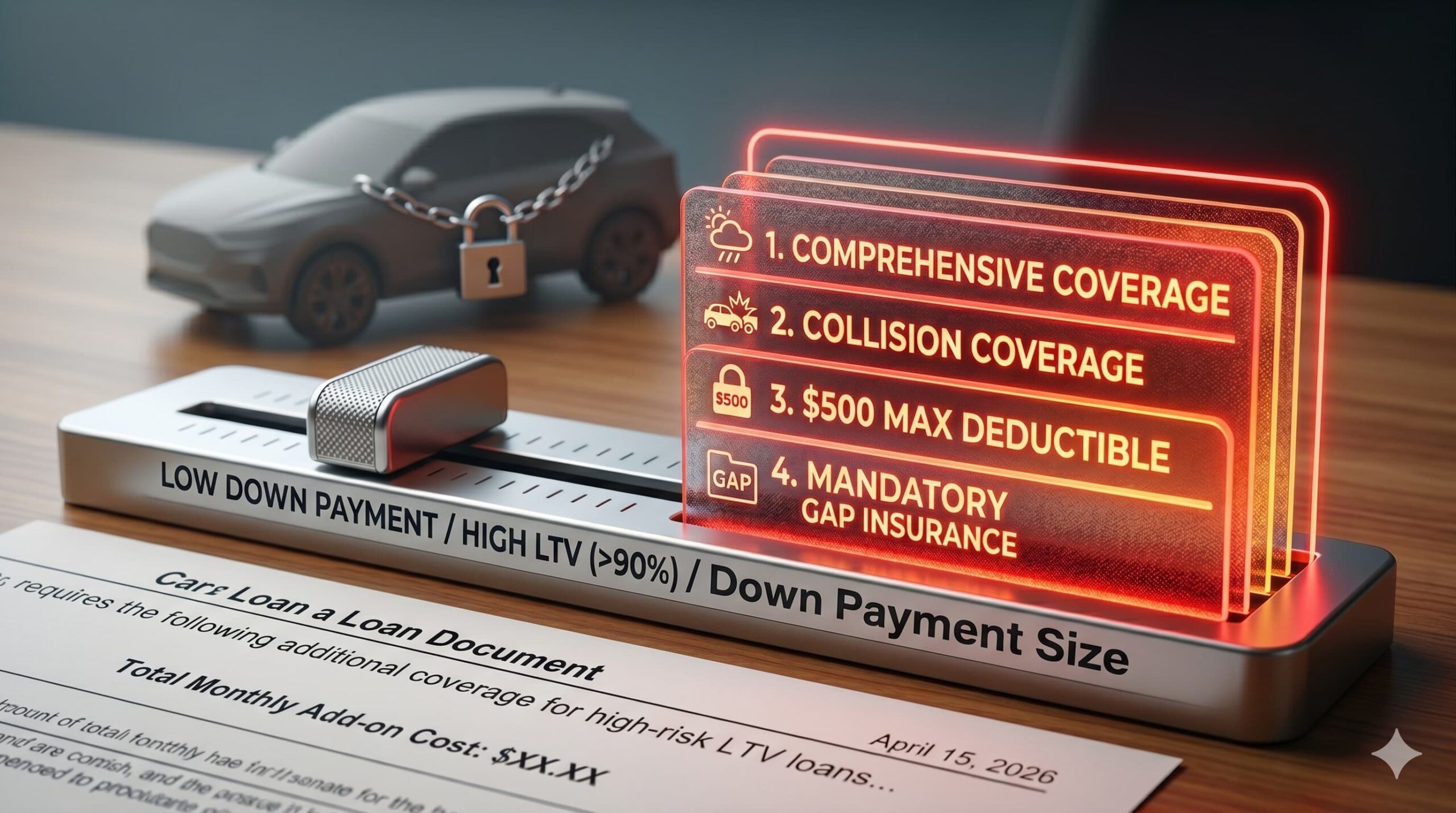
When the loan documents arrived, there was a lender addendum requiring comprehensive and collision coverage with deductibles no higher than $500, plus a gap insurance requirement.
Your current liability-only policy didn’t qualify. The lender’s forced-placed insurance option would have cost $180 a month.
That scenario is more common than most buyers expect… And it’s almost entirely driven by one decision made before the purchase: how much you put down.
Why Your Lender Has a Say in Your Insurance Policy
When you finance a vehicle, the lender holds a security interest in the car until the loan is paid off. The vehicle is their collateral. If the car is totaled or stolen and your insurance doesn’t cover enough to pay off the loan balance, the lender loses money.
That’s why lenders impose minimum insurance requirements. Not primarily to protect you, but to protect their collateral position.
What many buyers don’t realize is that these requirements aren’t uniform across loans. They vary by lender and, critically, they often depend on your loan-to-value (LTV) ratio… The size of your loan relative to the vehicle’s current market value. Your down payment directly determines that ratio at origination.
How Down Payment Size Changes Your Coverage Requirements
High LTV Loans (Under 10 Percent Down)
If you finance 90 percent or more of the vehicle’s value, most lenders treat the loan as high-risk. At this LTV, requirements typically include comprehensive coverage, collision coverage, deductibles no higher than $500… And in many cases mandatory gap insurance, either from the lender directly or a third-party insurer you select.
The CFPB’s auto lending consumer complaint database includes thousands of entries related to unexpected insurance add-ons on high-LTV loans. Many are from borrowers who didn’t realize gap coverage had been added to their loan balance at signing. Understanding what’s required before you sign prevents that outcome.
Mid-Range LTV Loans (10 to 20 Percent Down)
With 10 to 20 percent down, you’ll still face comprehensive and collision requirements on most loans, but the gap insurance mandate varies.
Some lenders require it at 85% LTV and above; others set the threshold at 90%. Ask specifically before signing. The difference affects your monthly insurance cost by $20 to $40 per month, which adds up to $480 or more per year over a 72-month term.
Lower LTV Loans (Over 20 Percent Down)
At 80 percent LTV or below, meaning you put at least 20 percent down, many lenders drop the gap insurance requirement entirely.
You’ll still need comprehensive and collision coverage for the life of the loan, but the cost of ownership decreases because the gap mandate is removed.
Understanding how LTV affects your loan terms goes beyond just the interest rate.
Putting 20 percent or more down often eliminates the lender’s gap insurance requirement entirely. This can save $20 to $40 per month on top of the lower loan balance and reduced total interest.
What Gap Insurance Covers and When You Actually Need It
Gap insurance covers the difference between what your standard auto insurance pays out (the car’s current market value at the time of the claim) and what you still owe on the loan if the car is totaled or stolen.
Example: You owe $34,000 on a car currently worth $30,000. It’s totaled. Your collision coverage pays $30,000. Gap insurance covers the remaining $4,000 still owed to the lender. Without it, you’d write a check for $4,000 on a car you no longer have.
When Gap Insurance Is Worth the Cost
Gap coverage is most valuable when:
- you made less than 20 percent down;
- you financed a vehicle that depreciates quickly (new vehicles in popular segments lose 15 to 25 percent of value in year one, per Edmunds);
- your loan term is 72 months or longer; or
- you rolled negative equity from a previous loan into the new purchase.
All four conditions are common on high-LTV loans. Any one of them creates meaningful gap risk.
When You Can Skip It
If you put 20 percent or more down and chose a 48- or 60-month loan term, your loan balance drops quickly enough that you’re unlikely to be significantly underwater for more than a few months.
At that point, gap insurance costs more than the gap it would cover. The math shifts against buying it.
Gap insurance is most valuable on new cars financed with less than 20 percent down on a 72+ month loan. If none of those conditions apply, you may be paying for protection whose cost exceeds the risk it covers.
How to Calculate Whether a Larger Down Payment Saves You Money Overall
Before finalizing your down payment amount, run through three separate cost factors:
- Monthly payment reduction: Each additional $1,000 in down payment reduces your monthly payment by roughly $18 to $22 at current rates, depending on term and APR.
- Insurance requirement change: If crossing the 20 percent threshold removes a mandatory gap requirement, that’s $240 to $480 per year in insurance savings over the life of the loan.
- Total interest reduction: A larger principal balance means more interest accrues. On a $40,000 vehicle, putting down $8,000 instead of $4,000 saves approximately $600 to $900 in total interest on a 60-month loan at 8% APR.
The benefit of a larger down payment is not just a lower monthly payment. It’s a lower insurance mandate, less total interest, and faster equity build. All simultaneously.
For buyers using a tax refund as a down payment, putting that refund toward the 20 percent threshold can generate returns across all three categories.
What Happens If You Don’t Meet Your Lender’s Insurance Requirements
If your policy lapses or falls below your lender’s minimum requirements, the lender can place force-placed insurance on the vehicle — also called collateral protection insurance (CPI).
This coverage protects the lender’s interest only, not yours, and typically costs two to five times what a standard full-coverage policy would cost for the same vehicle.
Force-placed insurance does not cover your personal liability, personal property, or medical costs. It is not a substitute for your own policy.
The CFPB has documented force-placed insurance as one of the more common consumer harms in auto lending, in part because many borrowers are not clearly notified when it has been added to their account.
If you receive notice that force-placed insurance has been applied, contact your insurer immediately to reinstate adequate coverage.
The lender is required to remove the forced coverage and refund the cost once you provide proof of a qualifying policy. See how loan insurance add-ons can inflate your total cost for a broader look at this issue.
Lenders also care where the car actually lives, not just how it’s covered. If a financed vehicle spends most of the year somewhere other than the address on the policy, such as a child’s car garaged at college, the garaging address itself can be rated wrong, This is a separate problem from meeting the lender’s coverage minimums.
Ready to compare your options? Get a free auto insurance quote and make sure your coverage meets your lender’s requirements.
Frequently Asked Questions
Can I choose my own insurance company when my lender requires full coverage?
Yes. Lenders set coverage requirements — what type of coverage and what deductible limits — not which insurer you must use. You’re free to shop for the best rate on a qualifying policy from any licensed insurer, as long as the policy meets the lender’s minimum specifications.
How long do lenders require comprehensive and collision coverage?
For the full life of the loan. Once the loan is paid off, you are no longer legally required to carry comprehensive and collision — though it may still make financial sense depending on the vehicle’s age and remaining value. Dropping to liability-only after payoff is a decision you make based on your own risk assessment, not lender mandate.
What’s the difference between what my lender requires and what my state requires?
State minimum requirements typically cover only liability — protection for other people if you cause an accident. Lenders add comprehensive and collision requirements on top of that because those coverages protect the vehicle itself, which is the lender’s collateral. The two sets of requirements are separate and additive. You must meet both.
Does my down payment size affect my insurance premium directly?
Not directly. Insurers price based on the vehicle, your driving record, location, and credit score — not your loan terms. But your down payment determines whether your lender requires gap insurance, which adds a separate monthly cost. It also affects how quickly you build equity, which determines when it’s financially rational to reduce coverage.
Is dealer-sold gap insurance worth the cost?
Typically not. Gap insurance financed into the loan means you pay interest on the gap premium for the life of the loan. Buying gap coverage directly from your auto insurer typically costs 50 to 70 percent less than dealer-sold gap, and you’re not financing it. If your lender requires gap, buy it from your insurer — not through the dealership.