
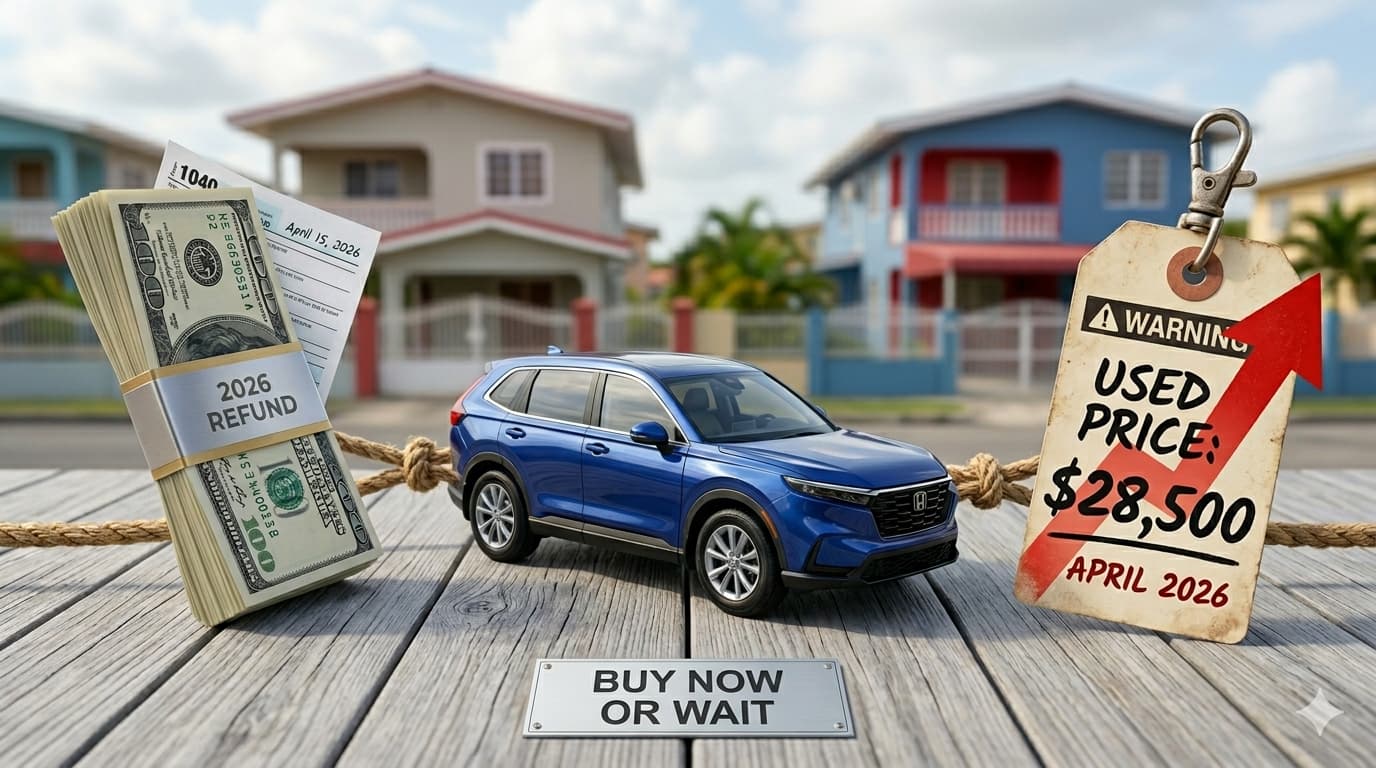

A tax refund can provide extra money toward a vehicle purchase, but using it wisely requires looking beyond the down payment. Consider the purchase price, financing, and ongoing ownership costs.
Imagine your refund hit your bank account three days ago. It’s $3,400, bigger than last year, and you’ve been eyeing a 2023 Honda CR-V at $28,500.
The timing feels right. Spring is traditionally when dealerships clear inventory. But this April, used car wholesale prices just hit their highest point in nearly three years. Before you treat that refund as a down payment, the market data says you should look at what’s driving that number.
One in three active car buyers in 2026 plans to put their tax refund toward a vehicle purchase, according to recent Axios reporting. With refunds running up to $1,000 higher than 2025, that buying surge is measurable in the wholesale price data.
The Manheim Used Vehicle Value Index rose 6.2% year-over-year in early 2026… And demand pressure from refund-season buyers is part of what’s pushing it.
That means the same refund that feels larger in your account is competing against more buyers in the market for the same vehicles.
What the Used Car Market Actually Looks Like in April 2026
The used car market spring 2026 picture has two competing forces. Used retail sales are up roughly 2% above year-ago levels, according to Cox Automotive Q1 2026 data.
At the same time, new car average transaction prices have climbed to near $50,000, pushing more buyers into the used market. When new becomes unaffordable, used absorbs the overflow, and prices respond accordingly.
The seasonal pattern that made spring traditionally a buyer’s market (tax refunds generating down payment cash while dealers still had model-year carryover to move) no longer cleanly holds.
Inventory on late-model used vehicles remains tight. Dealers are not sitting on surplus. The leverage has shifted.
The two prices to watch
Wholesale prices, tracked by Manheim, are what dealers pay at auction. Retail prices, what you see on the lot, follow wholesale with a markup that fluctuates by dealer and market.
When wholesale rises sharply, retail tends to follow within four to eight weeks. If the Manheim index is already elevated in March, the retail impact is already priced in or arriving by April.
Waiting may not rescue you from the price environment… But waiting until May or June, when refund-season demand typically clears, often does soften the retail side of the equation.
New car prices are not coming down
New vehicle average transaction prices in Q1 2026 are running about 3.5% higher year-over-year, putting the average approaching $50,000, according to Cox Automotive data.
Tariffs on imported vehicles and components are part of what’s keeping new prices elevated. If your plan was to use the refund to bump from a used vehicle to new, the math is harder than it was two years ago.
Key takeaway: Tax refunds are larger in 2026, but used car prices are at three-year highs. The refund that feels like a windfall is competing in the same supply-constrained market that caused those prices to rise.
When Using a Tax Refund as a Down Payment Makes Sense
The core logic for a tax refund down payment is sound: more down means less financed, which means less interest paid over the loan term.
At current auto loan rates of around 7.5% on a 48-month loan, per Federal Reserve data, putting an additional $2,000 down on a $28,000 loan saves roughly $320 in interest over the life of a 60-month loan. That’s real money, even if it’s not dramatic.
The down payment case is strongest when:
- Your loan-to-value ratio on the vehicle is tight (you’re financing a high percentage of an older vehicle)
- Your credit score puts you in a rate bracket where reducing the financed amount has meaningful monthly payment impact
- You have three to six months of emergency reserves after applying the refund as down payment
That last point is the one most buyers skip. A down payment that drains your emergency reserves trades a lower loan balance for financial fragility.
Car repairs, job disruptions, and medical expenses don’t pause for vehicle debt. If the refund is your primary cash cushion, preserving it as liquid savings and taking a marginally higher loan balance is often the more resilient choice.
The case for waiting 6 to 8 weeks
If your vehicle need is real but not urgent, the seasonal pattern favors patience. Refund-season demand in used car markets typically clears by late May, and retail prices on late-model used vehicles often soften 2-4% through June as dealer lots replenish and urgency drops.
On a $28,000 purchase, a 3% price drop is $840. This is comparable to the interest savings from a larger down payment, without requiring you to spend the refund at all.
The two savings compound when timed together: wait, buy at a softer price, and put the refund toward the purchase.
How to Evaluate a Specific Used Vehicle in This Market
Aggregate market data tells you the environment. Vehicle-level research tells you whether a specific listing is priced appropriately within that environment.
These are separate questions, and conflating them leads to overpaying for a reasonably priced car or passing on a good deal because the market generally looks expensive.
Check the listing age before the price
A vehicle that has been sitting on a lot for more than 30 days in a tight market is a signal. Either the price is above market, there’s something in the vehicle history deterring buyers, or both.
Days-on-lot data is available through most major listing aggregators. Vehicles listed over 45 days give you negotiating room even in a seller’s market.
Use the VIN before making an offer
In a market where used supply is tight and dealers have pricing power, the vehicle history report matters more, not less. Rental history, prior damage disclosures, and title issues are exactly the kinds of facts that get soft-pedaled when demand is high.
Understanding VIN transparency on listings explains what to verify before you make any offer.
Key takeaway: Checking days-on-lot and running the VIN takes about 20 minutes and can surface negotiation leverage or red flags that aggregate price data won’t reveal.
Separate the vehicle price from the financing offer
Dealerships frequently present the two together as a package. The conversation often goes: “We can get you into this for $489 a month.” That monthly payment rolls in the vehicle price, the loan rate, the term, and often add-ons.
N)egotiating on price first and financing second (ideally with a pre-approval in hand from your own bank or credit union keeps the two levers separate and prevents payment manipulation from obscuring what you’re actually paying for the car.
Getting pre-approved before hitting the lot also gives you real rate data. Dealer financing can be competitive, but only if you know what your baseline rate is. Without a pre-approval, you have no reference point.
See our overview of how loan pre-approval shapes negotiation power for the mechanics of using it effectively.
Ready to compare your options? See current auto loan rates from top lenders and find the best fit for your budget.
Frequently Asked Questions
Is spring really a good time to buy a used car?
It depends on your specific vehicle category. Tax refund season drives demand for lower-cost used vehicles, pushing prices up through March and April. Prices on those segments often soften in May and June. Higher-trim used vehicles and late-model certified pre-owned follow different seasonal patterns driven more by new model introductions in late summer and fall.
How much of my tax refund should I put toward a car?
No more than what preserves at least three months of living expenses in liquid savings after the purchase. The down payment math on interest savings is real but modest. Financial resilience after the purchase is a bigger variable than the incremental interest you save by maximizing the down payment.
Can I negotiate on a used car when the market is tight?
Yes, especially on vehicles that have been on the lot for more than 30 days. In a high-demand environment, dealers are less motivated to deal on freshly acquired inventory. But aged inventory carries holding costs, and a specific, researched offer referencing the vehicle’s time on lot gives you a legitimate negotiating frame even in a seller’s market.
Should I buy now or wait for used car prices to drop?
If your need is urgent — your current vehicle is unreliable or already gone — buy now with the best research you can do and negotiate on vehicle-level factors. If you have flexibility, the May–June window historically offers 2–4% price softening as refund-season demand clears. On a $25,000 vehicle, that’s $500–$1,000 in potential savings.
Does a larger down payment help if my credit isn’t great?
Sometimes. A larger down payment reduces lender risk, which can make approval easier and occasionally improves your offered rate. The effect is most pronounced when the loan-to-value ratio on the vehicle is high and your credit profile is borderline. If you have solid credit, the rate improvement from a larger down is usually minimal — the savings come primarily from financing less.